How Old National Bank Collected 50k+ New Leads in Their ‘Choose Your Charity’ Campaign
Old National Bank turned its community giving budget into a two-week online voting contest, letting the public choose which local nonprofits received funding. The Choose Your Charity campaign converted 62.5% of visitors, generated 107,941 votes, collected 50,415 unique email addresses, and distributed more than $265,000 to 97 nonprofits across the bank's Upper Midwest footprint.
:format(webp))
Old National Bank's Choose Your Charity campaign turned a community giving budget into major community engagement that included 107,941 votes and 50,415 unique email addresses, all while helping their community with a $265,000 donation. Here is how it was built and how Old National turned their charitable giving campaign into an engagement powerhouse.
Old National Bank x ShortStack
Old National is the sixth-largest commercial bank headquartered in the Midwest and a top 25 U.S. bank. With $74 billion in assets, it offers consumer and commercial banking, along with wealth management and capital markets services across seven states.
Casey Merkwan, Community Marketing & Engagement Manager and AVP at Old National, describes the bank's position this way:
As a regional bank with $74 billion in assets, we have the heart, culture and DNA of a smaller community bank. We are proud to have strong relationships with our clients and communities and an inclusive work environment that empowers our team members to deliver their best.
Old National has been a ShortStack user for the last 3 years and uses the platform to run one campaign per year - a fairly common pattern. Plenty of marketing teams run a flagship campaign annually, often a large giveaway like Choose Your Charity, and ShortStack is built to support that model. Subscriptions are available monthly or annually. On a monthly plan, the Old National team can build the campaign, run the voting period, and collect its data within a few months, then cancel without paying for the rest of the year.
The Choose Your Charity Campaign
Casey's team set a straightforward goal: make it easy for clients and community members to vote online for their favorite nonprofit, and donate to those nonprofits based on community support.
The mechanics were built to spread participation across a wide geographic footprint. Any registered 501(c)(3) organization within the bank's Upper Midwest footprint was eligible. Community members could vote once every 24 hours during a two-week window, with no requirement to be an Old National customer. The nonprofit with the most votes in each of 97 banking center communities received $2,500, and the top vote recipient overall received an additional $25,000. That put a $27,500 grand prize in front of every nonprofit in the running.
Old National promoted the campaign through four channels at once: organic social media, direct email to clients, radio, and digital ads.
Because the campaign allowed repeat voting, once every 24 hours, the team had to keep reminding people to come back. Paid and broadcast channels drove the initial awareness while email and social carried the daily reminder.
Results
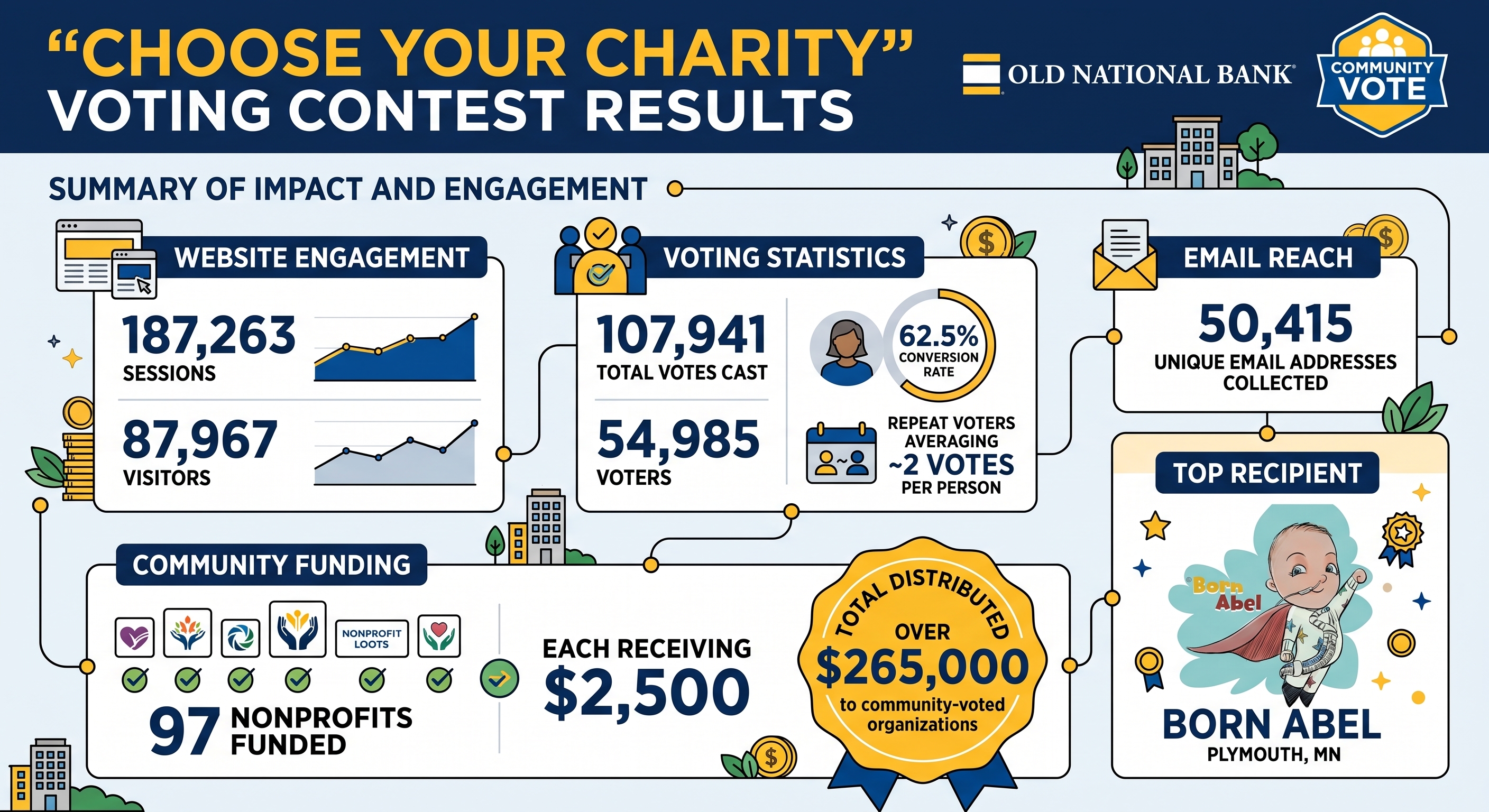
107,941 votes were cast by 54,985 individual voters.
62.5% of visitors voted. Nearly two out of three people who reached the page completed an entry, which is a conversion rate most campaign landing pages do not come close to.
Voters came back. Participants could vote once every 24 hours, and they averaged just under two votes each across the two weeks. Repeat participation, not first-time traffic, produced roughly half the total vote volume.
50,415 unique email addresses were collected. Because each vote required a form submission, the campaign also built a list the Old National team can use for future campaigns.
97 nonprofits received funding, each taking $2,500 in their local community. The overall top vote recipient was Born Abel in Plymouth, Minnesota, an all-volunteer 501(c)(3) that works to highlight and normalize children with complex medical conditions.
More than $265,000 was distributed to organizations chosen entirely by community vote. Winners ranged from animal rescues and fire departments to food pantries, Boys & Girls Clubs, Habitat for Humanity affiliates and free libraries.
The volume did not catch the team off guard, but the platform's ability to absorb it mattered.
We expected a large amount of engagement, and were pleased to have a platform that could handle that volume.
Casey pointed to campaign reporting as the most valuable part of the build. Being able to see how many votes came in over the course of the campaign, and how many people were engaging with it, gave the team a live read rather than a post-mortem.
The entry data also had a second life after voting closed. Old National shared it with individual banking centers so local teams could follow up with nonprofits that did not win their community, where that outreach made sense. A campaign designed to distribute donations also produced a map of which organizations matter most to each local community.
When asked about return on investment, Casey listed outcomes rather than a single figure: brand recognition in the bank's newer markets, additional press coverage after the winners were announced, and reinforcement of the bank's community commitment in public view.
Why Voting Contests Work for Community Brands
Choose Your Charity works because the prize is not the point. The bank was going to donate the money regardless. Putting the decision in the hands of voters turned a line item into a two-week conversation across three states, and gave 97 communities a reason to talk about their local nonprofits and the bank funding them.
For a regional brand growing into new markets, that is a more useful outcome than a list of leads. And it is repeatable. Old National runs it once a year, in a new part of its footprint each time.
Ready to write your own success story?
If your brand has budget earmarked for community giving, a voting contest turns that spend into engagement. Start building for free or book a demo to talk through your campaign ideas.