How to Pick a Fair, Auditable Winner from a Comment-to-Enter Contest (Without Scraping)
To pick a fair, auditable winner from a comment-to-enter contest, import every comment into a structured entry list instead of scraping the post, apply clear eligibility rules to filter out duplicates and spam, then run the draw from that complete, timestamped list. This creates a record you can show if a winner is ever questioned—something a scraped or partial comment pull can't reliably provide.
:format(webp))
Running a "comment to enter" giveaway sounds simple: post something, ask people to comment, pick a winner. But the step everyone glosses over is how you actually pick that winner — and whether you could prove, if someone asked, that the process was fair.
Most comment-picker tools skip past that question entirely. They paste in a post URL, scrape whatever comments they can grab off the page, and spit out a name. It feels random. It looks legitimate. But "looks random" and "is defensible" are two different things.
Here's how to run the process the right way, step by step.
Step 1: Understand Why Scraping Isn't a Safe Foundation
Before picking a method, it helps to know why so many free comment-picker tools are riskier than they appear.
Scraping tools grab comment data directly from the post's page, the same way a browser would display it. They don't go through the platform's official API to get permission-based, structured data.That approach runs into a few problems:
- It violates platform Terms of Service. Every major platform prohibits scraping. A tool built this way can be cut off at any time, with no warning.
For example, this is straight from TikTok’s Terms of Service agreement:
You must not use, or help anyone else use the Platform to scrape, crawl, export or otherwise extract any data or content in any form, for any purpose, from the Platform using any automated system or software, including automated “bots,” except as approved in writing by TikTok USDS Joint Venture,
- It's fragile. Platforms change their layout and anti-bot measures constantly. A scraper that works today can silently break tomorrow.
- It rarely captures every comment. Comment feeds are algorithmically sorted and paginated. Heavily-commented posts can throttle a scraper before it reaches the full list.
That last point is the one that actually matters for fairness. If your winner was chosen from an incomplete list of entries, you don't have a random draw. You have a partial one — and that's a hard thing to explain if a participant asks why they weren't included.
Step 2: Import Comments Instead of Scraping Them
The fix is straightforward: use a tool that imports comments through the platform's official channel rather than scraping the page.
Importing means every comment on the post gets logged into a real entry database, with a timestamp and a record of who posted it. Nothing is left out because a scraper hit a rate limit halfway through. Nothing depends on the platform's front-end staying exactly the same from one day to the next.
This is the model ShortStack's Comment-to-Enter tools are built on. Instead of grabbing a snapshot of visible comments, ShortStack imports the full comment set into a structured entry list you can actually see, filter, and export.
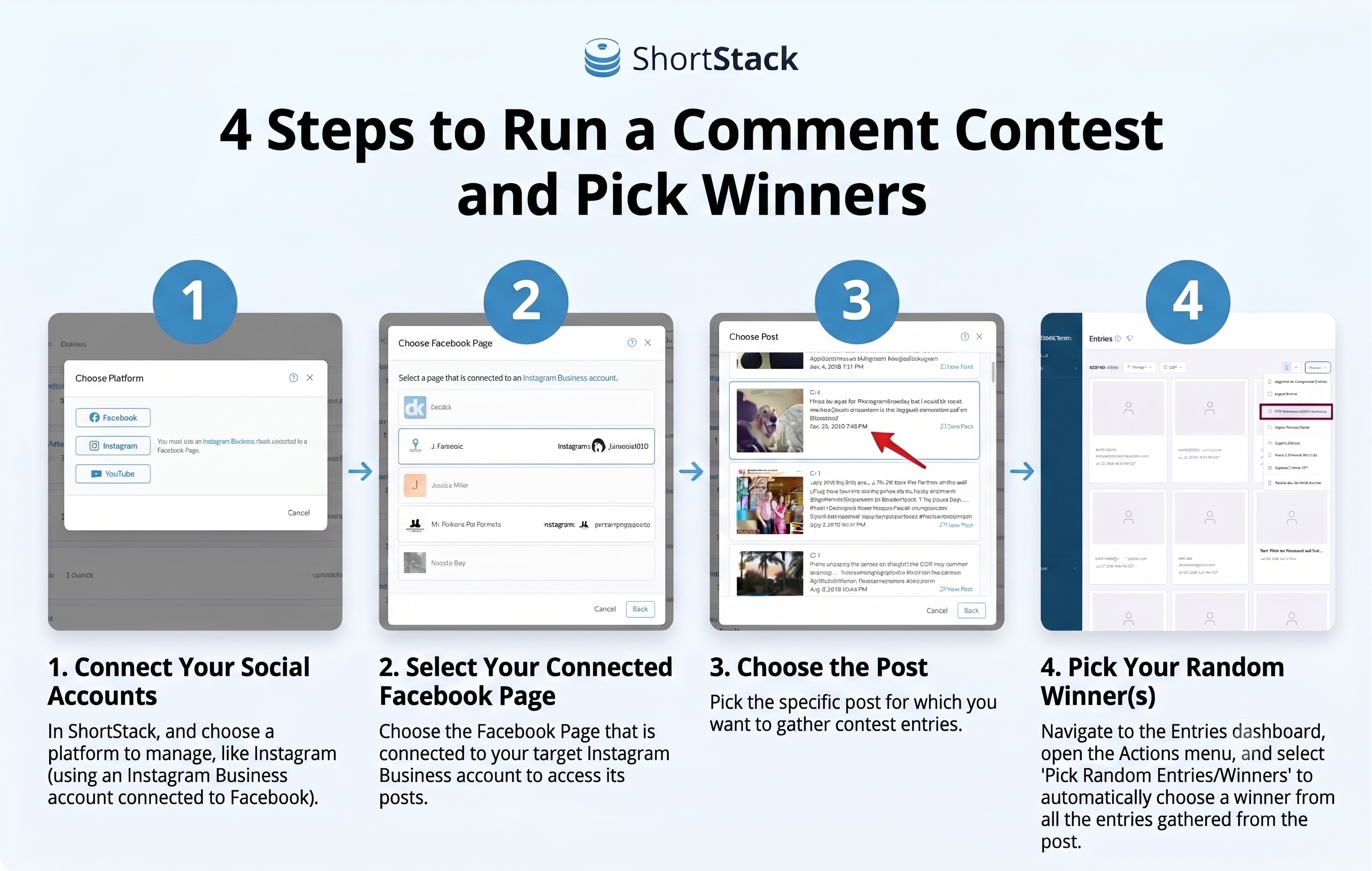 How to import comments and choose a winner in ShortStack
Step 3: Set Clear Entry Rules Before You Launch
A fair draw starts before the contest even goes live. Decide upfront:
- Does one comment count as one entry, or can people comment multiple times to get more entries?
- Are there eligibility requirements (following your account, tagging a friend, using a specific hashtag)?
- What disqualifies an entry (spam, bots, duplicate accounts)?
Write these rules down and publish them alongside the giveaway. If a winner is ever questioned, having published rules to point back to is half the battle.
Step 4: Filter Entries Before Drawing a Winner
Once comments are imported into an entry list, filter it. This is a step scraping tools generally can't offer, because they're just handing you a raw pull of whatever text was on the page.
With an imported entry list, you can typically filter out:
- Duplicate comments from the same user, if your rules only allow one entry each
- Comments that don't meet your stated criteria
- Obvious spam or bot accounts
Filtering before the draw, rather than trying to explain exceptions after the fact, is what makes the results easy to defend.
Step 5: Run the Draw and Keep the Record
Once your entry list is clean, the actual winner selection should be the easy part; a true random draw from a complete, filtered list. What matters most here is keeping the record.
A defensible process means you can show, after the fact:
- The full list of eligible entries
- The filtering criteria applied
- The exact winner selection, tied to a timestamp
This is the audit trail that a scraped snapshot simply can't produce, because a scraper only ever shows you what it managed to grab in that moment. There's nothing to go back and verify.
Step 6: Be Ready to Show Your Work
Most giveaways never get questioned. But the ones that do tend to get questioned publicly, in the comments of the very post you ran the promotion on. Having an exportable, timestamped entry list ready to reference turns a potential dispute into a two-minute response instead of a scramble.
This is also the difference that matters if you're a marketing consultant running promotions on behalf of clients. "We used a tool that scraped the post" is not a great answer if a client asks how a winner was picked. "Here's the full entry list, the filters we applied, and the exact draw record" is.
The Takeaway
A fair, auditable comment-to-enter contest depends on three things: complete entry data, clear rules applied consistently, and a record you can point back to. Scraping tools can't reliably deliver any of the three, because they were never built to.
If you want to run comment-to-enter giveaways on a foundation that holds up, see how ShortStack's Comment-to-Enter campaigns work and run your next contest with an entry list you can actually stand behind.
:format(webp))
:format(webp))